
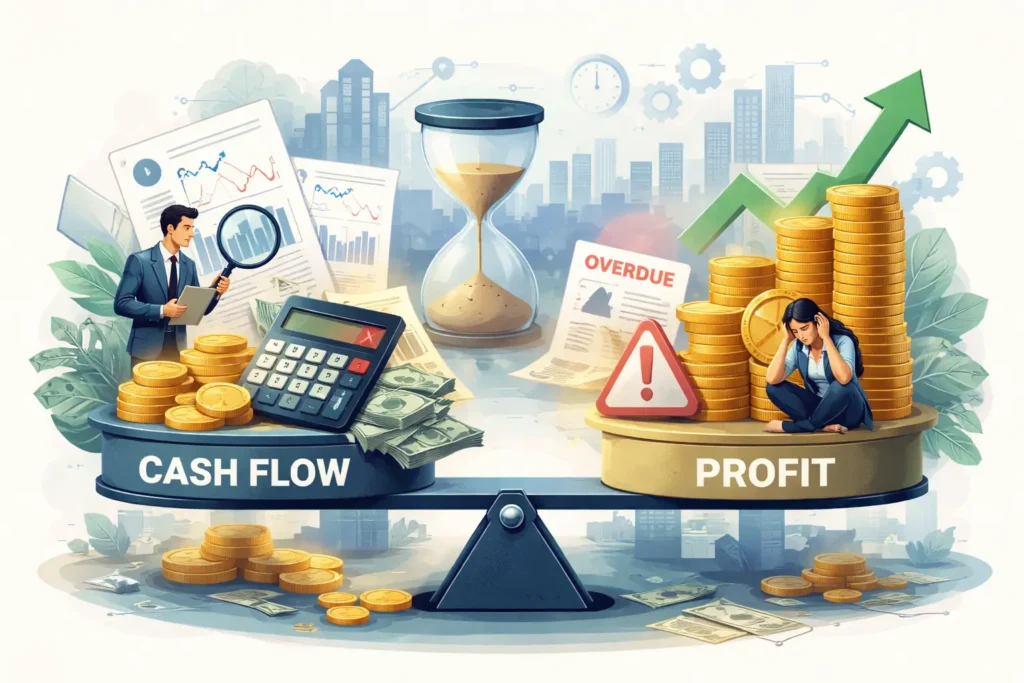
Around 60% of Australian small businesses that fail are technically profitable at the time of failure (Source: Australian Securities and Investments Commission, 2023). Profit on paper does not pay wages, rent, or suppliers. Cash flow does. Understanding the difference between cash flow and profit is not an accounting technicality; it is a survival skill for every business owner.
This article explains why cash flow and profit diverge, why profitable businesses still run out of money, and what practical steps you can take to fix cash flow problems before they become terminal.
What is the difference between cash flow and profit?
Profit is what remains after you subtract expenses from revenue on your profit and loss statement. Cash flow is the actual movement of money in and out of your bank account. The two numbers are often very different because profit is calculated on accrual accounting, it records revenue when it is earned, not when it is received.
A business can show a $50,000 profit for the quarter while having zero cash in the bank, if all that revenue sits in outstanding invoices. That is the fundamental tension between cash flow and profit.
Accrual vs cash accounting – why it matters
Most businesses in Australia use accrual accounting, which means revenue is recorded when a sale is made and an expense when it is incurred, regardless of when money actually moves. A business that invoices $100,000 in June but collects nothing until August shows strong June revenue, but has a cash problem in July. Cash accounting records revenue and expenses only when money actually changes hands.
| Profit (Accrual) | Cash Flow | |
| Records revenue when… | The invoice is issued | Payment is received |
| Records expenses when… | Bill is received | Bill is paid |
| Shows business health? | Profitability over time | Ability to pay bills now |
| Main document | Profit & Loss Statement | Cash Flow Statement |
Why do profitable businesses fail in Australia?
Profitable businesses fail when they cannot meet short-term obligations, such as wages, rent, supplier invoices, and loan repayments, because money owed to them has not yet arrived. This is called a liquidity crisis. ASIC data shows that inadequate cash flow is a primary or contributing cause in the majority of business insolvencies across Australia (Source: Australian Securities and Investments Commission, 2024).
Slow-paying customers (debtors)
Extended payment terms of 30, 60, or 90 days mean businesses might have to wait months to receive payment for work already completed and costs already incurred. During that gap, the business must still pay its own obligations. When several large invoices are outstanding at once, even a healthy business can face a serious cash shortfall.
Rapid growth
Growth is cash-hungry. When a business wins new contracts, it must hire staff, buy stock, and invest in resources before it receives payment from clients. This growth gap, funding the cost of expansion before revenue arrives, is one of the leading causes of cash flow crises in otherwise profitable businesses.
Seasonal revenue
Many Australian businesses experience sharp revenue peaks and troughs throughout the year. A retail business that earns 40% of its annual revenue in November and December must carefully manage costs from January through October. Without a cash reserve or access to a credit facility, slow months can become dangerous months.
How do you improve cash flow in a small business?
Improving cash flow requires action on both sides of the equation: accelerating cash inflows and managing cash outflows. The most effective businesses treat cash flow forecasting as a routine management activity, not an emergency response.
Invoicing faster and following up sooner
Send invoices the moment a job is complete. Set payment terms of 14 days rather than 30. Automate payment reminders through your accounting platform at 7 days, on the due date, and at 1 day overdue. Every day an invoice sits unpaid is a day your cash position weakens. Working with a professional team for accounts receivable management can significantly reduce your average debtor days and tighten your collection cycle.
Build a cash flow forecast
A 12-week rolling cash flow forecasting process, updated weekly, shows you where shortfalls are coming before they arrive. List every expected cash inflow (customer payments, tax refunds, loan draws) and every outflow (wages, rent, suppliers, loan repayments, tax obligations) for each week ahead. When a gap appears, you have time to act: delay a non-critical expense, draw on a credit facility, or accelerate collection from a debtor.
Negotiate payment terms with suppliers
If you pay suppliers in 14 days but collect from customers in 45, you have a structural cash flow problem regardless of your profit margins. Negotiate extended terms with key suppliers of 30, 45, or 60 days where possible. Even a small extension on large regular purchases meaningfully improves your working capital position.
Conclusion
Cash flow vs profit is not a theoretical distinction; it is the difference between a business that survives and one that does not. Profitability shows that your business model works. Cash flow shows whether it will make it through the next 90 days. The businesses that manage both well treat cash flow forecasting as a regular discipline, not a crisis response. If you are profitable but perpetually short of cash, the question worth sitting with is: are you actually running a business, or just financing your customers?
KEY TAKEAWAYS
- Profit is recorded on your P&L when revenue is earned; cash flow tracks when money actually moves in and out of your account.
- A business can be profitable and insolvent at the same time this is the most common cause of business failure in Australia.
- Slow-paying customers, rapid growth, and seasonal revenue are the three biggest drivers of cash flow crises.
- A 12-week rolling cash flow forecast is the most practical tool for identifying and preventing cash shortfalls.
- Aligning your payment terms with suppliers to your debtor collection cycle is a structural fix that improves cash flow permanently.
Q: What is a healthy cash flow ratio for a small business?
A: A common benchmark is an operating cash flow ratio of 1.0 or above, meaning the business generates at least $1 of cash for every $1 of current liabilities. However, ideal ratios vary significantly by industry. Retail businesses typically operate on tighter ratios than professional services firms.
Q: How often should a small business prepare a cash flow forecast?
A: A 12-week rolling forecast updated weekly gives most small businesses sufficient visibility. Businesses in high-growth phases, seasonal industries, or those experiencing stress should consider a daily cash position report. Monthly forecasting alone is generally too infrequent to catch problems before they become urgent.
Q: Is it better to use cash or accrual accounting for a small business?
A: Accrual accounting gives a more accurate picture of business performance and is required for GST reporting by most businesses. Cash accounting is simpler but can misrepresent true financial position. Most businesses with turnover above $10 million must use accrual accounting (Source: Australian Taxation Office, 2024).

Ayushi is a Certified Practising Accountant (CPA) and registered tax agent with a Master’s degree in Accounting and over five years of experience serving Australian clients. She has delivered end-to-end accounting and tax services to businesses across retail, food & restaurants, healthcare, construction, and sole trader structures. Ayushi helps Australian business owners and individuals cut through the complexity of tax and accounting with confidence.